Our Approach

In 2021, Myanma Awba decided to structure its approach to sustainability. Led by the Group’s CEO, this project involved all our business functions and units. A new sustainability officer was appointed, and the Group partnered with a local consultancy to:

  • Identify and engage with our key stakeholders
  • Prioritise our issues and structure our approach
  • Structure our reporting and collect data

Prioritisation

We initially identified 48 topics related to environmental, social and governance issues. To prioritise them, we met with:

  • 8 representatives of external stakeholders, including our farmers, distributors, business partners, experts on responsible business conduct, etc.
  • 25 internal stakeholders, including the Executive Chairman and 1 member of the Advisory Board, and most of the members of the Executive Committee, to gather their feedback and insights.
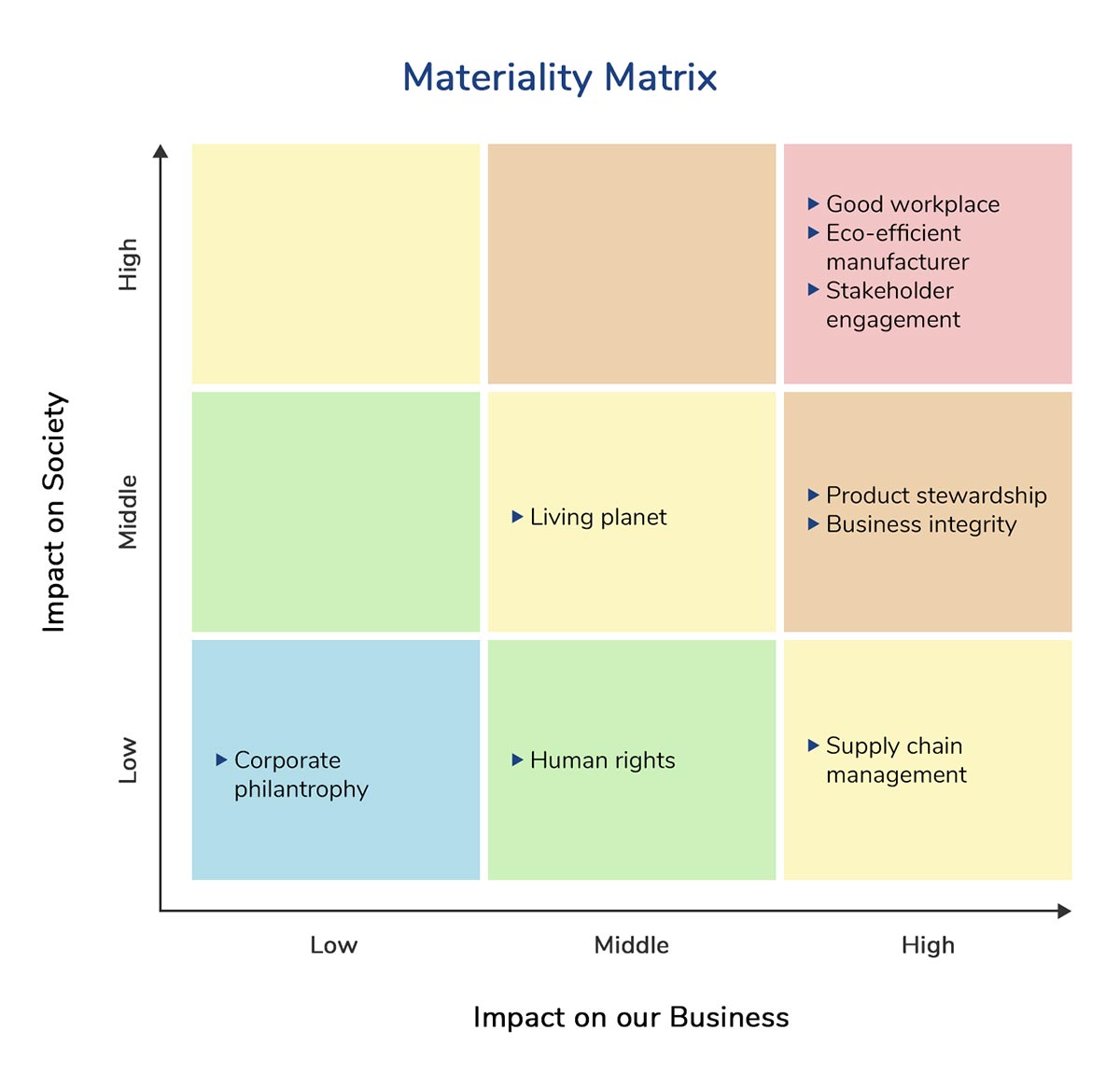
    The result of this prioritisation was approved by the Group CEO: the matrix details our 9 core priorities.

Sustainability Strategy

Farmers are the backbone of Myanmar’s economy. Their work is essential: they supply us with nutritious food while providing income for rural communities. Therefore, to deliver on our mission, Myanma Awba develops products and solutions that enable Myanmar’s farmers to better cultivate their crops.

Our sustainability strategy, Better Awba, articulates four pillars:

Standards

We consider four main standards in shaping and structuring our non-financial reporting:

Sustainable Development Goals

Currently, we consider the following SDGs the most relevant to Myanma Awba Group:

SDG Rationale Key figures (FY 23/24)

Agriculture is the backbone of the Myanmar economy. Fostering sustainable farming is critical to enhancing crop productivity and uplifting the livelihoods of thousands of farming communities across the country.

  • We partner with 4,600+ distributors to serve hundreds of thousands of farmers across the country.
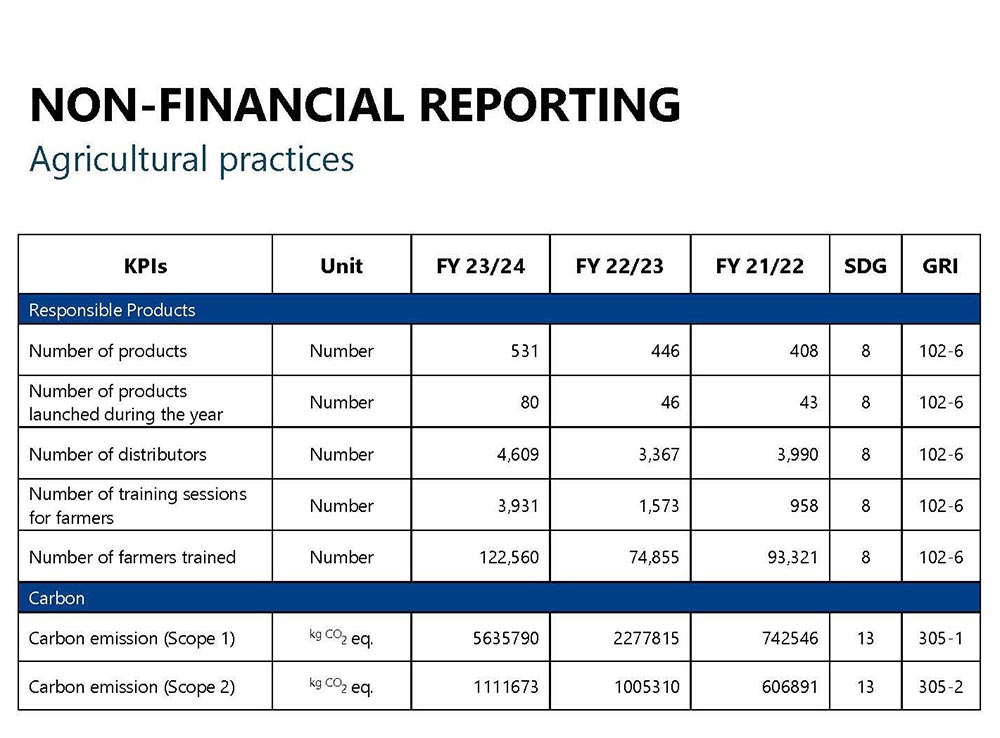
  • Our experts organised 3,900+ training sessions and engaged with 122,500+ farmers to share their expertise.

As a responsible Group of companies, we aim to provide fair, inclusive and respectful working conditions to our staff. Myanma Awba Group is part of the Business Coalition for Gender Equality.

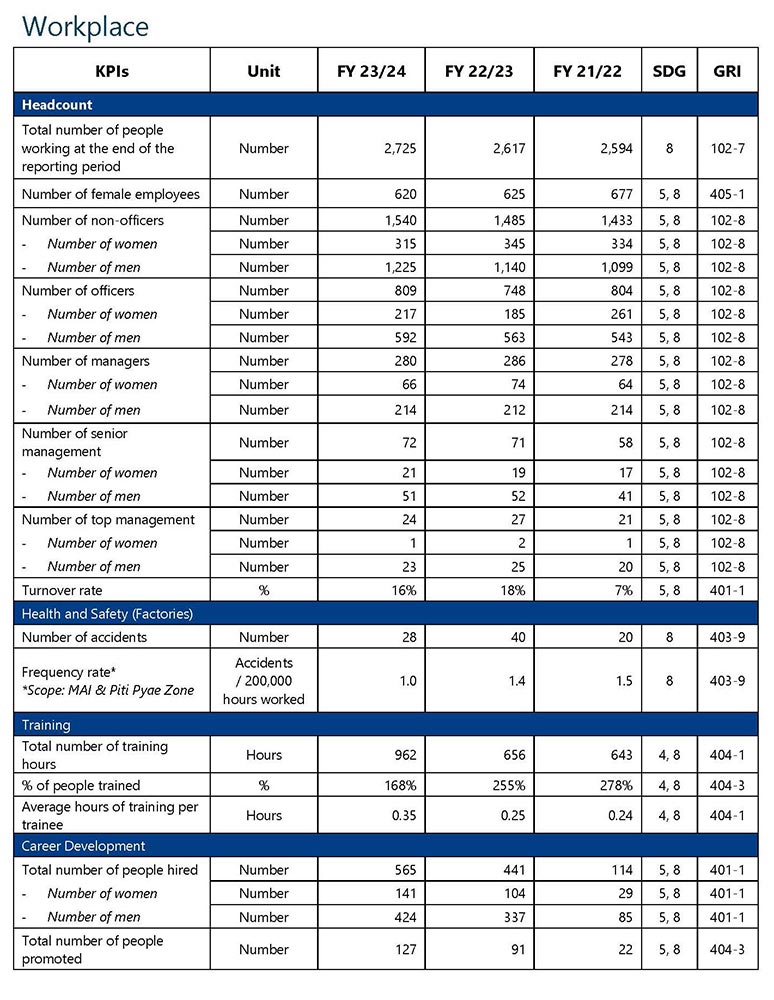
  • 23% of our staff are women.
  • 23% of our management positions are held by women.
  • 25% of those promoted were women.

As a company, we work to sustain our business: it generates jobs directly for our staff and indirectly for the people working with our suppliers.

  • We had 2,725 staff by the end of March 2024.
  • We hired 565 employees and promoted 127.
  • We worked with 1,499 suppliers, of which 97% were Myanmar-based.

To operate, our production plants need to withdraw and discharge water. Therefore, we carefully monitor our activities to ensure that they do not lead to local problems such as pollution, water shortages, etc.

  • We consumed 61,228 cubic meters of water and discharged 1,742 cubic meters.

We use various chemicals and materials to manufacture our products. We ensure that Myanma Awba complies with all the necessary rules and requirements for storing and transporting hazardous materials.

  • We used 183,000+ metric tonnes of raw materials.
  • Our activities induced 576 metric tonnes of waste, and we recycled 438 tonnes.

Myanmar is one of the countries that will be heavily impacted by climate change, which will impact farmers most of all. We are working to reduce our energy consumption and our CO2 emissions.

  • We emitted 6,747 tonnes of CO₂ equivalent.
  • 84% of our emissions pertained to Scope 1. .

Bees and other pollinators are critical for sustainable farming: they enable crop growth and food production. The responsible use of our products is essential in protecting biodiversity and natural ecosystems.

  • We ran over 1.7 million of communication campaigns, mainly through Printed media, to raise awareness regarding the responsible use of our products.

GRI Standards

Our non-financial reporting is aligned with the Global Reporting Initiative (GRI) Standards and will follow the GRI Sector Standard for Agriculture before 2024. The following GRI material topics are considered relevant to our non-financial reporting:


Our GRI Index is available here.


One of our affiliates, Maha, discloses its own sustainability reports every year. They can be found here.


Our Data

All the data included on our website has been reviewed and validated by the Myanma Awba Group management on 24 February 2024. All the quantitative data covers FY21/22 (from October 2021 to March 2022) and FY22/23 (April 2022 to March 2023) unless stated otherwise. The qualitative information covers the period from January 2022 to March 2023.

The data include all the entities operated by Myanma Awba, which are mentioned here. The data disclosed has not been audited by a third party.

Myanma Awba welcomes your feedback and questions. You can contact our Group Chief Sustainability Officer by email at nyinyikyawlwinoo@awba-group.com and corporatecommunication@awba-group.com.

GRI topics GRI material topics
Economic topics
  • 201 – Economic performance
  • 203 – Indirect economic impacts
  • 204 – Procurement practices
  • 205 – Anti-corruption
Environmental topics
  • 301 – Materials
  • 302 – Energy
  • 303 – Water and effluents
  • 306 – Waste
Social topics
  • 401 – Employment
  • 403 – Occupational health & safety
  • 404 – Training & education
  • 405 – Diversity & equal opportunities
  • 406 – Non-discrimination

If you are passionate about agriculture and believe in its significance in changing lives, join us.

Explore a career with us