Business Practices

As a responsible company, Myanma Awba strives to do the right thing when we engage with our business partners and suppliers or manufacture our products. We ensure that our operations comply with all relevant rules and regulations.

Eco-efficient Manufacturing

To manufacture our products, we rely on materials, energy and water. By optimizing the efficiency of our industrial processes and monitoring our impacts carefully as set by our policy, we aim to minimize our environmental footprint – what is good for the planet is also good for our business. We are working to save energy and save as much waste as possible.

Value Chain Management

We work closely with various partners to import raw materials and transform them into finished products, and with 900+ distributors to reach hundreds of thousands of farmers across the country.

We assess our risks and engage with all the different actors who are essential for delivering value to Myanmar’s farmers through our products.

Human Rights

Myanma Awba is committed to respecting human rights. We assess risks related to human rights and ensure that we can provide effective remedies whenever needed.

  • We recorded 9 breaches of our Code of Conduct.
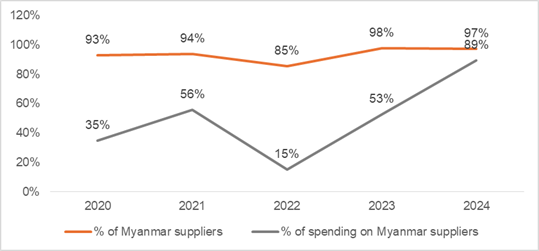
  • 97% of our suppliers are Myanmar businesses.
  • 89% of our spending went on Myanmar suppliers, an increase from 53% last year.
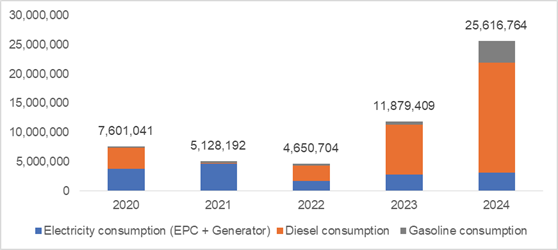
  • We consumed 25,616 MWh in 2024, from which 94% of our energy consumption comes from diesel.
  • Our total energy consumption increased by twice in FY23/24 compared to FY22/23, as the electricity supply from EPC continues to be significantly lowered.
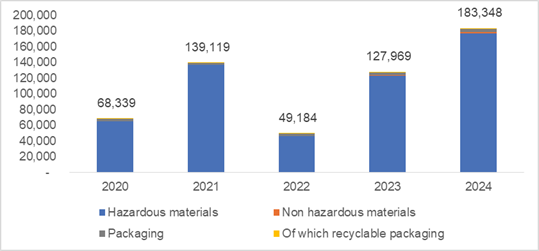
  • We consumed 183,348 tons of raw materials, of which 97% were hazardous materials.
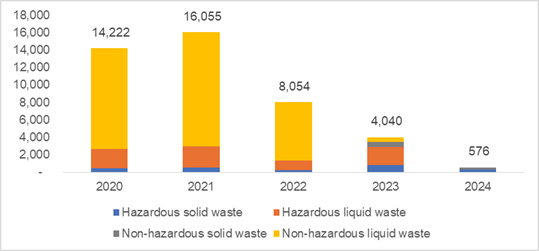
  • Our total production of waste decreased by -86% in 2024.
  • 76% of our waste was recycled, 3% were recovered, and 21% were landfilled respectively.
  • We consumed 61,228 cubic meters of water and discharged 1,724 cubic meters.
  • We are committed to respecting human rights, and regularly assess risks related to our people, partners and customers.

Evolution of our energy
consumption (kwh)

Evolution of our supply chain

Environmental and Social Impact Assessment

AWBA Group hears and understand the concerns of the villagers of Hmawbi Township and is therefore committed to ensuring our plant – Hmawbi Agricultural Input Complex (HAIC) – are in line with international health, safety and environment standards.

To this end, we engaged a third-party to conduct an Environmental and Social Impact Assessment (ESIA) based on the Environmental Laws of 2003.

After revised environmental regulations were put in place by the Ministry of Environment in December 2015, we conducted a new ESIA with the guidance of the International Finance Corporation (IFC). This latest assessment is complete and submitted to the Myanmar Investment Commission and the Ministry of Natural Resources and Environment.

Myanma Awba Group received the Environmental Compliance Certificate (ECC-1016) for HAIC in October 2024 ,Ref: EIA-3/2/ECC(EIA)(4944/2024), confirming compliance with Myanmar’s Environmental Conservation Law, EIA Procedure requirements, and commitment to sustainable, responsible operations.
Grievance Mechanisms at Work in Hmawbi Community

What is a Grievance Mechanism?

A tool developed to create healthy and informative communication between project-affected community members and AWBA, should a complaint or suggestions arise.

AWBA’s Unique Beliefs and Approach

  • Training community volunteers
  • Utilising engaging tools such as cartoons to effectively teach
  • Posting a sign board and distributing informational pamphlets to community

How They Work

Create two-way communication between community members and AWBA

Ensure community members are given a voice

Mitigate and manage risks associated with the project

Obtain social licence to operate in the community

Community Volunteers

Community volunteers from the village are selected in order to inform their community about new methods for reporting complaints and suggestions, known as grievance mechanisms. They are key in liaising between the community and the respective business.

  • “Only collaboration can generate outcomes that are good for both parties.”

    Daw San San Myint

    Kyauk Taung Su
    Wa Net Chaung Ywar Ma

  • “My view is that we must not just expect things from someone, but we also must put effort and work into addressing problems together.”

    U Ye Linn Naing

    A Shay Pine – 2
    Wa Net Chaung Ywar Ma

  • “I volunteer because I would like to learn about the information, processes, and share my knowledge and experience with my community.”

    U Khin Maung Oo

    Kyein Ni San Boe
    Daw Na Kone Village group

If you are passionate about agriculture and believe in its significance in changing lives, join us.

Explore a career with us